Pretalx CFP Reviewer Guide

Oluwatosin Olatunji, Justin Wheeler Version 1.1; 2026-02-10
Thank you for contributing as a reviewer for Flock to Fedora! Your expertise is vital in shaping an outstanding conference experience. This guide is designed to streamline your navigation of the Pretalx review process for Flock.

This page provides guidance to call for proposal (CFP) reviewers for the Flock to Fedora conference. CFP reviewers are invited as volunteers by Flock core organizers to help curate diverse content and programming at our contributor conference.

Your feedback should be constructive, insightful, and focused on the content of the submissions. Your role plays a significant part in ensuring a high-quality experience for Flock.

This guide is organized into multiple sections below.

Gain Reviewer account access

You will receive an invitation from a Pretalx administrator with login instructions. You will be prompted to create a reviewer profile if it is your first time.
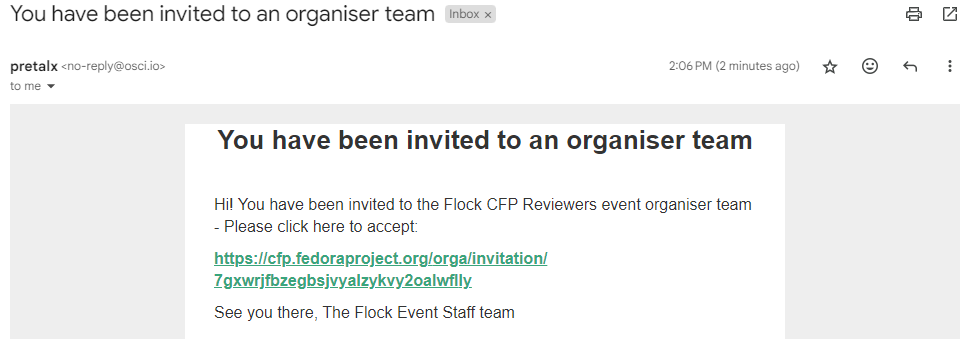
Screenshot of the email invitation sent by the Pretalx system to the user’s email inbox. The email subject reads
Figure 1. Email invitation from Pretalx
Screenshot of the dialogue to accept the email invitation to join a Pretalx team. Two options are presented to accept
Figure 2. Accepting the invitation on Pretalx

View proposals

Upon logging in, your dashboard will display a list of proposals assigned to you for review. Also note that depending on settings, reviewers will be able to view and review all proposals, or only assigned proposals (determined by the Pretalx administrator).
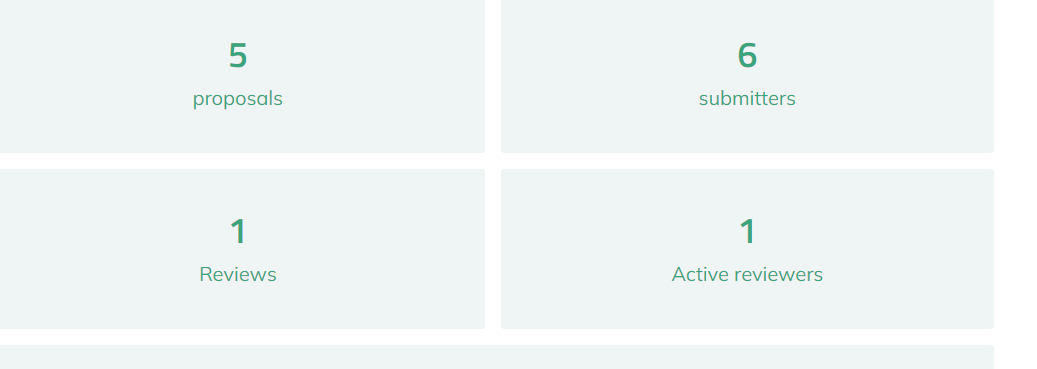
Screenshot of the reviewer dashboard from Pretalx. Four panes are shown: 5 proposals
Figure 3. Reviewer dashboard in Pretalx

Review proposals

A Pretalx proposal submission is typically composed of a title, abstract, track, theme(s), a brief speaker bio, and other notes. If blind review for reviewers is enabled, speaker identities are hidden.

All reviewers can give up to four points to a session. Each point is weighed on a different criteria, much like a rubric. The four point categories guide each reviewer to reflect on four different aspects of the proposal:

  1. Submission Quality: The basics. Is the proposal well-written? Is it thoughtful? Does the speaker adequately describe their topic in a way that others can understand?

  2. Theme Relevance: All proposals link themselves to one or many of the four themes: *Freedom* – The Open Frontier; *Friends* – Our Fedora Story; *Features* – Engineering Fedora’s Core; *First* – Blueprint for the Future: Fedora Linux 45 & 46. Does the connection between the proposal and theme make sense? Is it a good fit?

  3. Probability of Success: Is the speaker adequately prepared to deliver their content? If they will run a workshop, will it connect to the Flock audience and attendees? If they present a session, do they have a clear connection to Fedora? What is the likelihood that this session contributes to something positive for the future of Fedora?

  4. Personal Appeal: This is your personal point. Use it however you want! If there is a session you just really like and you have a hard time explaining why, this point is for you. Alternatively, if there is something you really don’t like, you can also downvote it (although we likely want to know why in the comments).

The following sections explain each point in more detail and provides guidance to CFP reviewers on how to cast a vote.

Q1: Submission Quality

  • Give one point (+1): If abstract is written clearly and the submitter did a good job of describing their topics. It should be clear what the submitter will talk about and why their topic(s) are relevant to the Fedora contributor community.

  • Give no point (+0): They submit an interesting abstract, but there are missing details or uncertainties about what the submitter will prepare.

  • Take one point (-1): The abstract is poorly written and/or it is unclear what the speaker is proposing.

Q2: Theme Relevance

  • Give one point (+1): The proposal has a clear connection to a Flock 2026 theme. The submitter acknowledges the focus area in their abstract or describes the connection between the focus area and their topic(s) well.

  • Give no point (+0): The proposal acknowledges a theme, but the submitter does NOT connect the theme and their topic(s) well.

  • Take one point (-1): The proposal does not acknowledge a theme or seems irrelevant to the theme selected by the submitter.

As a reminder, the Flock 2026 themes are below:

  • Freedom – The Open Frontier: This theme explores how Fedora pushes the boundaries of technological freedom. We invite proposals on FOSS approaches to Artificial Intelligence, the advancement of open hardware like RISC-V, the development of open standards, and the protection of data privacy. Sessions should focus on how our work in the Fedora Project creates a more free and collaborative technological world for everyone.

  • Friends – Our Fedora Story: This theme celebrates the people and practices that make our community unique. We seek proposals that share stories of mentorship, successful team collaboration, and effective onboarding within Fedora. Collaboration is key to our success, so sessions about our partnerships with other FOSS communities should center on the mutual benefits and the positive impact these relationships have on the Fedora Project.

  • Features – Engineering Fedora’s Core: As a contributor conference, this theme dives deep into the craft of building our distribution and other Fedora outputs. We welcome sessions on improvements to our infrastructure, release engineering processes, quality assurance, packaging, and community tooling. This is the place for technical talks that showcase our engineering excellence and the collaborative work that makes Fedora’s deliverables possible, from code to final artifact.

  • First – Blueprint for the Future: Fedora Linux 45 & 46: This theme focuses on the near-term innovations that will define the next generation of Linux. With the next few Fedora Linux releases serving as the foundation for RHEL 11 and EPEL 11, this is a critical time. We are looking for forward-looking technical talks on the changes, features, and architectural decisions in F45 and F46 that will shape the future of the operating system, from the community desktop to the core of the enterprise platforms.

Q3: Probability of Success

  • Give one point (+1): You believe that this proposal has a high probability of success at Flock. The speaker(s) appear to have sufficient knowledge and expertise to present the topic at Flock.

  • Give no point (+0): It is unclear whether the speaker will be able to deliver the content successfully at Flock.

  • Take one point (-1): You believe that this proposal will not be successful at Flock. This could be because the proposal is too ambitious, it is not relevant to a Fedora contributor audience, or the speaker does not seem to understand the topic they are proposing.

Q4: Personal Appeal

  • Give one point (+1): You see positive value for this session to be at Flock, based on your personal involvement with Fedora.

  • Give no point (+0): You see neutral value for this session to be at Flock, based on your personal involvement with Fedora.

  • Take one point (-1): You see negative value for this session to be at Flock, based on your personal involvement with Fedora.